
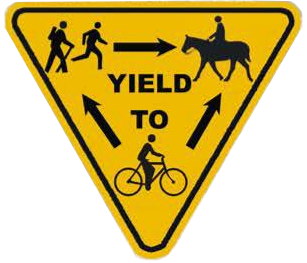
Yield means slow down, establish communication, be prepared to stop, and pass in a safe and friendly manner. Hikers yield to horses, and bikes yield to hikers and horses as shown by the arrows on the multi-use yield sign.
Respect
It’s a simple concept: If you offer respect, you are more likely to receive it. All trail users have rights and responsibilities to each other, and to our trails.
Smile, Greet, Nod
Every user on the trail is a fellow nature lover. Be friendly and expect to see other folks around every corner.
Stay on the trail
Only use officially designated trails and obey posted closures and other signs. Don’t go off trail, create new trails or cut switchbacks. Short-cutting switchbacks can cause extensive long-term trail damage.
Don’t use wet trails
If you are leaving deep prints (hoof, tire, or foot), or mud is sticking to your shoes or tires, the trail is too wet to use. When approaching puddles or muddy sections go through the center of the puddle to keep the trail narrow. Narrow trails mean less environmental impact and a close-to-nature feel.
Don’t block the trail
When taking a break, move to the side of the trail. Don’t stop or lay a bike or backpack on the trail, especially on a blind corner.
Don’t tune out
If you wear earphones, keep the volume down or only wear one earpiece so other trail users don’t surprise you.
Clean up after your dog
If you hike or ride with your dog, bring waste collection bags to clean up after your pet and PACK OUT the waste. Nobody wants to encounter your dog’s poop on the trail and it can contaminate streams.
Pack it in, pack it out
Don’t litter. Pick up and pack out any trash you may find, and everything you brought in. Every piece of litter removed reveals a little more of nature’s beauty. This includes cigarette butts which also present a fire hazard.
Help keep our trails safer and more enjoyable for all!
We all share a love of nature, open space and trails. It’s important that all hikers, equestrians, and mountain bikers unite to support and care for our trails and public lands. Shared-use trails are cost-effective, minimize impacts on the environment, provide the most users with the most trail opportunities, and build happier, healthier communities. We all value and support our public land managers and our trails community. Let’s work together to keep our trails safe and enjoyable for all.
Faster trail users. Listen for cyclists, runners, and equestrians approaching from behind, or those coming from ahead but out of sight. If you hear “on your left” from behind this means you should stay to your right to allow them to pass (and vice-versa).
Cyclists have a responsibility to yield and pass at a safe speed. Offer friendly communication to let the rider know when it’s safe to pass. Give a verbal or visual acknowledgement, step to the side of the trail or wave the rider by on wider trails.
Share the trail. When hiking in a group, hike single file on narrow trails or stay to the right side of a wider trail or fire road, leaving room for others to pass. Make sure everyone in your group understands what to do when encountering other hikers, bikes, and horses. When hiking downhill on narrow trails, yield to those hiking uphill.
If you wear headphones, keep the volume down or only wear one earpiece so you can hear other trail users approaching and avoid surprises.
Only take your dog on trails where dogs are allowed, and keep your dog on a short leash (6’ or less), especially when near horses, cyclists, and other hikers. Remember others others may be frightened by dogs or be unsure of how to pass safely. If your dogs don’t like strangers, bikes, horses, or other dogs, leave them at home.
Inexperienced trail users. While all trail users should yield to equestrians, many are intimidated by large horses, or just don’t know what to do.
Manage your horse. Train and familiarize your horse on wider multi-use trails with room to maneuver so the horse can become more comfortable with cyclists, dogs, backpack-wearing hikers, etc. Your horse should be comfortable with other trail users before venturing onto narrow shared-use trails. Consider
desensitization training for your horse if it remains skittish around other trail users.
Surprised trail users. Fast-moving bikes can startle others, especially when coming around a blind turn or approaching from behind.
Mountain bikers yield to hikers, horses and uphill-riding cyclists. SLOW DOWN around other trail users and anticipate people or animals around blind turns. Consider using a bell to help avoid surprising others. Be exceedingly friendly and communicative. On wider trails and fire roads keep to the right. Always ride
under control and avoid skidding. Never put others at risk.